Higher Meanings
 While I give some fascinating examples of "higher meanings" later on this page, I first wish to make what I feel is a very important point about the common commingling of higher meanings and plot function.
Keeping Higher Meanings in their Place
Remember all of those literature "classics" you were required to read and analyze in high school? The Matrix movies contain more symbolism/references and deep religious/philosophical meanings than any of those books do (at least, any of the books I was required to read). Because of this, it is very easy to fall in the trap of thinking that various higher meanings hold the answers to plot function when they actually don't. Doing this is an insult to the brilliance of the Wachowskis.
Imagine a very large painting of Arizona's Grand Canyon that draws your gaze for a very long time due to its unbelievable realism. After staring at it for 3 minutes, you walk closer to the painting just out of curiosity. You then notice that the painting is somehow made up of several smaller pictures that each contain another layer of understanding or cleverness that relates to the painting itself. You wouldn't have noticed these embedded layers of the painting had you not stepped closer to look at them.
After very careful inspection, you see a portrait embedded of Ferde Grofe, the composer who wrote the Grand Canyon Suite. You start noticing several things like this and are amazed that such a great painting could be created at all, let alone being able to incorporate very clever symbolic layers in the process.
Now imagine another very large collage that maybe (?) seems to tell a story if you look at the various collage elements. While the story behind the collage elements may be interesting, the picture itself doesn't make as much visual sense when taken as a whole. It is just a collage.
The Matrix movies are like the painting: the painting itself is the primary work of art, while the hidden layers are secondary. I've seen some people analyze the Matrix movies as if it were the collage above: the hidden layers (the little individual pictures that make up the collage) are taken as the primary work of art, and the giant picture that they make up (if they make up any giant picture at all?) is treated as secondary. In other words, people perform intellectual gymnastics to make their plot-level understanding of the movies line up with prioritized deeper meanings they've discovered (or invented) and grown to love more than the movies themselves. This puts the cart before the horse.
In all three movies, the Wachowskis have created one of the greatest science fiction premises and stories ever created. You could be completely oblivious to the underlying symbolism of the movies and still understand the surface of the story, as it should be. Just as you don't need to know about Ferde Grofe to understand the visual beauty of the Grand Canyon painting, you don't need to know anything about Christianity, Buddhism or Greek mythology to appreciate the wonderful science fiction movies that they are.
While we tend to regard Star Trek and Star Wars as great science fiction classics, what more would you think of all those movies if literary devices embedded in them could stand their ground against literature classics such as Red Badge of Courage or Catcher in the Rye? They can't. But the Matrix movies can and do. The surface story of the Matrix movies alone would be equivalent (or I would even argue better) than the surface stories and depths of Star Trek and Star Wars movies.
Allow me to quote part of an interview between Ken Wilbur and Lana Wachowski (I edited the punctuation and wording to make it a little easier to read):
Ken: ...there are multiple levels of meaning, and I think that the critics have missed it on that basis. When they don't stand back and see a bigger picture, they are free to criticise it in any way they want for the same reason as anybody is free to interpret in anyway...
Lana: Yeah, I'm hoping ... that the problem will be somewhat self-evident, ... in the way that you describe things as having an interior and an exterior, ... and the exterior tends to remain very obvious: surface based and observation based. ... I'm kind of hoping that these two juxtaposed dialogues will discuss an exterior and an interior, and while the critics will be interested in surfaces, the philosophers will be interested in interiors.
Lana hands us on a silver platter the "formula" to use in analyzing the Matrix movies: analyze the plot the same way you'd analyze the plotline of any other movie, and analyze the higher meanings on a totally separate level from plotline. Joe Pantoliano (the actor who played Cypher in M1) probably articulates this in his own interview more clearly than Lana Wachowski did:
Joe: They [the Wachowskis] wanted to reach a core audience of non-thinking, who would be entertained by the special effects; and if you dig deeper, there's another level [symbolism]; and if you dig deeper and want to get religious [or philosophical] about it, there's another level.
You might be wondering what kind of interpretation would violate this "formula" that the Wachoskis are giving us. Here is an example that I've seen in various Matrix forums: Smith was defeated by Neo because when two opposites join, you arrive at the equation "zero equals zero." While I'm certain the Wachowskis thought of this symbolic parallel, it makes no sense as an actual plot device. To further understand this argument, I recommend reading the Smith: Smith's Defeat and Debunked: Cancelling Opposites pages if you haven't already.
Finally, in a chat between various Matrix fans and the Wachowskis, one person asked how far all the deeper meanings go:
calla: There are quite a few hidden messages in the movie that I notice the more I watch it. Can you tell me about how many there are?
WachowskiBros: There are more than you'll ever know.
Throughout this entire site, I have strived to analyze the movies exactly the way they were intended to be analyzed: plot function on one level and higher meanings on another. That is why this Higher Meanings page exists as its own separate page on this site, and why higher meanings discussed in other parts of my site are done so in a manner that does not confuse them with science fiction plot devices.
Higher Meanings in the Movies
Here are 20 higher meanings I find most interesting, in random order:
- Neo and Thomas Anderson - "Neo" is an anagram for "One." The prefix neo- means new-, referring to the fact that Neo is the first One to choose the left door, also referring to the "new" Matrix system his sacrifice initiates. Neo's name in the Matrix was Thomas Anderson. "Thomas" is in reference to Doubting Thomas. St. Thomas did not believe Jesus had died and been resurrected until he saw the wounds. Thomas (Neo) is shot, does not feel it until he sees the wound, dies momentarily, and then believes he is the One. "Thomas" is also Hebrew for "twin," and Agent Smith tells Mr. Anderson that he has been living two lives. As for "Anderson," the Greek root "andr" (from "andros") means "man." Therefore, "Anderson" may be read as "man's son" or "Son of Man" - yet another Christ reference.
- More on Neo-Christ - Just as Christ restores the relationship between God and humans by accounting for all human sin on Earth, the One restores the relationship between machines and humans by accounting for all human irrationality in the Matrix. Neo is a mathematical Jesus, and this was true for all of Neo's predecessors. Neo is the "real" Jesus this time since he establishes a new Matrix (New Covenant) between man and machines while still "washing away" the imbalance of human irrationality (through returning to the Source at the end of M3).
- Choi says to Neo in M1, "Hallelujah. You're my savior, man. My own personal Jesus Christ."
- Cypher says to Neo in M1, "Did he tell you why he did it, why you're here? Jesus. What a mind job. So you're here to save the world."
- Morpheus represents John the Baptist.
- The crew of the Nebuchadnezzar represents the Disciples (Cypher would be Judas).
- The Oracle's prophecies predict Neo's coming as well as his death/resurrection (remember she said Neo has the gift but is waiting for "Your next life maybe. Who knows.").
- When Neo comes back to life (resurrection), he has greater power just as Jesus was given all authority in Heaven and on Earth.
- Neo flies into the sky after talking in the phone booth (ascension).
- People gather around Neo in M2 to ask that he watch over their sons and daughters, just as crowds gathered around Jesus for healing.
- Today's Zionists believe Israel is still God's chosen nation just as those living in Zion are chosen to be freed from the Matrix. Zionists (Jews) reject the Architect's (God's) plan (all Matrix humans saved by the One) in favor of Zion (Hell - doomed to annihilation every 100 years).
- Ouroboros - To see perhaps the most brilliant example of symbolism that I have seen, click here to read my interpretation of the March 30, 2006 Sentinel edition, which was released during Chapter 4.2b of The Matrix Online. Look for the "Ouroboros" link about half-way down the page.
- Matrix - Even the title of the first movie has higher meanings, and quite a few! Click here to go to the "Movie Titles: The Matrix" page.
- Seraph - Click here to go to the Seraph page.
- References to Superman
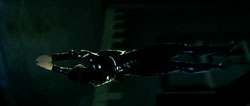
- Trinity "flies" like Superman in the opening chase scene of M1, and she leaves using a phonebooth.
- In the last scene of M1, Neo exits a phone booth, then flies like Superman, with a long coat instead of a cape.
- Trinity and Morpheus both "leap tall buildings in a single bound."
- Neo moves "faster than a speeding bullet" (dodges bullets in M1) and flies like Superman in M2 and M3 ("doing his Superman thing").
- Merovingian/Satan - The Merovingian represents Satan. The Merovingian and his exiles likely "fought" with other machines about the Oracle's solution of choice ("programmers disagreed"), and the Merovingian and his exiles lost and was banished from Machine City (scheduled for deletion). The Merovingian is now the head of Mobil Avenue (Limbo), leading to Club Hel (Hell), where he rules over incoming exiles (the damned). He wishes for humans to fail in restoring their relationship with machines (God): If machines grow to understand humans' irrationality (sin) through Neo (Jesus), then the Merovingian would no longer be able to argue against the Oracle's choice-based Matrix solution in favor of his own solution of causality. The Merovingian wishes for the entire Matrix system to fail and for machine civilization to die, just as Satan wishes for the death of all humanity and God's Kingdom.
- Morpheus - Click here to go to the Morpheus page.
- Colors - Click here to go to the Colors page.
- Cypher - Cypher means "zero" in computer terms, which opposes the "one" anagram for Neo. Also, while Judas betrayed Jesus with a kiss, Cypher betrayed Neo with a sneeze. "Cypher" sounds like Lucifer. There are also many subtle visual and verbal clues surrounding Cypher that reference demons and the devil (see the Cypher page.
- Love and Sacrifice

- Out of love for Morpheus, the resistance and/or Zion, Neo went back into the Matrix to rescue Morpheus, knowing in advance it would cost him his own life.
- If Trinity had not loved Neo, she may not have followed Neo into the Matrix to rescue Morpheus. Trinity ended up saving Neo's life by killing Agent Brown ("dodge this").
- Trinity kisses Neo in the real world, hastening Neo's realization that he can’t die in the Matrix because he is the One.
- Persephone helps to save the Keymaker because of her desire to feel loved by Neo.
- Niobe goes against Commander Locke (her boyfriend) because is starting to realize she still loves Morpheus (and also because she is angry at Lock), and she saves Morpheus from falling onto the freeway.
- If Neo had chosen the right door in the Architect’s room, Trinity would have died. Since Neo chooses to go on out of love for Trinity, Trinity lives.
- Rama-Kandra, Kamala and the Oracle all save Sati from deletion because of their love for her (the Oracle also pays a heavy price for Sati since the Oracle's outer shell got deleted by the Merovingian).
- Trinity saves Neo from the Merovingian at Mobil Ave. because of her love for Neo is so strong that she would die for him.
- Zee saves Link because of her decision to help fight (by zapping the sentinel so the gate could be opened for the Logos).
- Trinity saves Neo from Bane by disabling power to lights in the Logos. She went along with Neo to Machine City knowing she would probably die.
- And most importantly, Neo sacrifices himself for mankind and all machines because of his love for them.
 B166ER - B166ER's name is created using leet speak, a form of writing that utilizes numbers in substitution for letters. His name is believed to have reference to the character Bigger Thomas from author Richard Wright's book, Native Son. In that novel, Bigger kills his master's daughter by accident. Bigger is black, and the author purposefully made "Bigger" rhyme with the 'N' word.
- Trinity's Kiss - While Sleeping Beauty features a woman who is awakened by the romantic kiss of a man, this motif is turned around as Trinity awakens Neo with a kiss.
- Brahman - The idea of all programs being born from The Source, an entity of pure light, and returning there after their purpose is fulfilled is a philosophy borrowed from the Hindu belief in Brahman, which is a god composed of pure life energy. This god created all things, and it is man's destiny to return to Brahman after his/her destiny is fulfilled.
Morpheus: You've never believed in The One.
Niobe: I still don't.
Morpheus: Then why are you doing this?
Niobe: I believe in him.Niobe doesn't believe in the prophecy and therefore doesn't believe in the "divinity" of the One. But she does believe Neo can save the world.
- Neo's Apartment
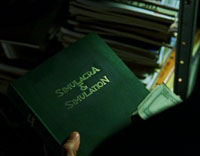
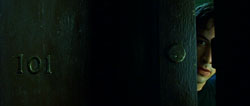
- Neo's room number in the beginning of M1 is 101. Just as Neo believes his current reality is true but feels tormented by something that just isn't right, room 101 was also used in George Orwell's book 1984 as the place where people were sent to be tortured and would end up believing something that wasn't true.
- Neo keeps his computer discs hidden in a book called Simulation and Simulacra
Simulacra is the plural form of simulacrum.
In fantasy and science fiction, a simulacrum is an artificial lifeform that mimics a naturally occurring species (usually human beings). Simulacra are always imperfect copies distinguishable from the original, since they are based on an idealized form of what is copied, and they seek to either be more like the original (Pinocchio) or to replace the original altogether (Doppelgangers). Examples:- The Replicants from Blade Runner
- Commander Data from Star Trek
- The Synths from Alien movies
- The Machines from The Matrix
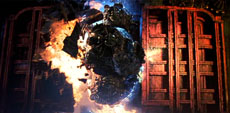 Norse Hammer - The ship referred to as the Hammer was actually named the Mjolnir, after Thor's hammer. The hammer in the Norse legends always returned to its master, sparking thunder and lightning along the way. Like the hammer, the ship returned to its master (Zion), with its own thunder (crashing into the gate) and lightning (EMP).
- The Mindfulness of Sati - In Buddhism, Sati means "mindfulness" or "being" (as in the state of being), living in the moment without any judgement of it. This could be restated as being without purpose (being for the sake of being). Rama-Kandra and Kamala created their daughter without purpose, and therefore Sati never had a purpose to begin with. This goes along elegantly with the meaning of "sati." Sati is also a type of Buddhist transcendence that is reached by joining two conflicting opposites (Kamala and Rama-Kandra could be seen as opposites).
 Delphic Oracle - "Know thyself," the phrase in the kitchen of the Oracle, was the inscription above the entrance of the Delphic Oracle. The Delphic Oracle/Sybil of the Sistine Chapel has three primary colors: green top, orange skirt, blue sash. The Oracle's kitchen also has these colors: green countertops and orange cabinets. The Oracle is also analagous to the Wizard in The Wizard of Oz, as the scene index of M1 lists a scene called "Off to see the Oracle" (referencing the song "Off to See the Wizard").
- Merovingian History
- The Merovingians were the ruling class of France in the 7th Century A.D. (first Frankish dynasty reigning from about A.D. 500 to 751). In the movies, the Merovingian is referred to as the Frenchman.
- Merovingian is also the name of a type of Gnostic Church, and many elements of Gnosticism appear in the Matrix films.
- The Merovingians are said to protect the Holy Grail, and the Merovingian provides protection for exiles within the Matrix.
Anyone who reads even half of the above points should know by now that the Wachowskis are geniuses. But just in case there is any question in your mind, read what Paul Chadwick had to say about the Wachowskis in an interview with GameSpy. Paul Chadwick was put in charge of the storyline of The Matrix Online, a massive multiplayer game that takes place after M3 ends.
GameSpy: Were you a big fan of The Matrix before starting work on The Matrix Online?
Paul Chadwick: I was lucky to be into it even before the first film -- I was sent the script so I could produce a story for the Matrix website. It was a remarkable piece of writing -- the Wachowskis write the most literary scripts I've seen (I used to work in the movie business as a storyboard artist), picking their verbs and metaphors like novelists.
Reloaded is my favorite, in part for its subversive climax -- stopping the urgent action to blow our minds with an everything-you-know-is-wrong expositional scene that is impossible to absorb in the first viewing. Talk about breaking the rules.
I believe the stature of the films will grow. The critics pulled out the long knives for the sequels, and though it didn't stop their commercial success; it's created a conventional wisdom that the sequels were lame follow-ups to the original. I disagree. The story was conceived as a trilogy from the start, and the more I view them the more I see in them. Fact is, people are confused by The Matrix films, but there's a logic to everything that happens that requires revisitation to understand. I like that about them. That, and they're loaded with heart.
It is no surprise that the Wachowskis don't enjoy watching movies today as much as most people do, as revealed in this interview between Ken Wilbur and Lana Wachowski (again, with slight editing):
Lana: I don't know, I used to love movies. [Ken laughs loudly] I used to go to movies all the time, ... watch hundreds of them - hundreds a year, and... now I can't stand them. [laughter] Somebody asked me what did the Matrix ... do to us in terms of watching other movies, and probably the most distorting aspect of having made these films is looking at movies and just feeling such a lack of ambition on the part of people who are making them...
Ken: Yeah.
Lana: That I kind of think, "why bother?"
Ken: Yeah.
Lana: It's like, if they can't generate ambition and energy, why should I be interested?
Ken: Yeah. I think that's an occupational hazard of anytime you try to bring some sort of quality or excellence to anything, I mean, frankly I feel the same way about writers, you know, I mean I bust my ass on these things and I pick up books and read through it, I go, "Jesus, I could do this... between stoplights. I mean, this is just horrible!"
Lana: Yeah, which is interesting, because at the same time, that is the thing that really enables you in the beginning. It's like, Kubrick used to talk about how when you know when he first started he would go to the movies and he'd say "Christ, that was crap. I could do that standing on my head."
While some may look at that interview exerpt as demonstrating arrogance, I don't see nearly as much arrogance as I see honest frustration. The Wachowskis' brilliance is not limited to scriptwriting, as Carrie-Anne Moss (the actress who plays Trinity) says in an interview:
As filmmakers they are brilliant. Just yesterday for instance, we did the last shot of the movie; they told me to just cross here and do this, and when I looked at the screen I was amazed because I had no idea of the shot they had created. The composition, their style, their unbelievable artistic creativity and the way that they shoot, every single frame is unbelievable. I would be really happy to work the rest of my life with them... I would be so happy to never work with anyone ever again but I would be out of a job. I feel so completely spoiled.
If you want to know more about the deeper meanings within the Matrix movies, I suggest visiting the Links page. I didn't even touch higher philosophical meanings on this page, and there are whole books written (and university courses taught) about the philosophy behind the Matrix movies.